






A PAGCOR spokesperson spoke to Focus Gaming News about legislative reforms, the proposal to ban online gaming, illegal market risks, privatisation plans, and 2025 regulatory priorities.

Exclusive interview.- The gambling industry in the Philippines is in the midst of intense debate surrounding a series of reforms and stricter rules that could completely change the sector’s ecosystem.
On the one hand, lawmakers are discussing the possibility of banning online gaming. Meanwhile, the central bank has told e-wallets to remove links to gambling platforms in their apps. They are also creating stricter rules for payments and, at the same time, PAGCOR’s e-games segment has overtaken traditional casinos as the industry’s main growth driver. This has led to a debate about how best to regulate the market and stop illegal gambling.
In light of this, Focus Gaming News sat down with a PAGCOR representative to discuss the regulator’s position on suggested laws, the risks of a complete ban versus stricter rules, how delinking e-wallets might affect legal operators, steps being taken to protect consumers, progress in anti-money laundering after the FATF’s departure, how the industry is performing, the privatisation process, and PAGCOR’s regulatory priorities for the rest of 2025.

How does PAGCOR view the recent legislative proposals aiming to introduce a new regulatory framework for online gambling in the Philippines? What role would PAGCOR play under such a system?
We respect all the proposals from our lawmakers, both in the Senate and in the House of Representatives. That is their right, and it is indeed their duty to study the various laws currently in place.
PAGCOR is aware of proposals calling for a total ban on online gaming, while others propose stricter regulation.
PAGCOR is not in favour of a total ban and instead advocates for stricter regulation. We believe that a thorough study must be conducted before any new rules are implemented to ensure a sustainable but responsible gaming regime.
Right now, the real problem is the illegal operators. Unfortunately, many of these unregulated online operators are based overseas who target Filipinos, most of whom do not realise that the sites they are playing on are not licensed by PAGCOR. This is where problems arise, especially regarding age restrictions.
New regulations would allow PAGCOR to more effectively carry out its role of ensuring that all online gaming operators and service providers strictly comply with the guidelines and other laws governing online gaming, and that the interests of the government and the public are well protected.
President Marcos Jr. has stated he is open to reviewing proposed online gambling legislation. Has PAGCOR been consulted in this process, and what recommendations has it provided?
PAGCOR has conducted several briefings for the country’s economic managers on the issue to explain how a total ban would impact the economy and how players would simply migrate to illegal sites, thus depriving the government of much-needed revenues while illegal online gambling continues.
PAGCOR’s CEO has warned that a total ban would drive players to illegal operators. Has PAGCOR modelled the potential size of the illicit market under a ban scenario?
Even now, while online gambling is legalised, we estimate that the unlicensed operators hold a 60 per cent share of the market.
If online gaming were to be totally outlawed, not only will the share of underground operators be at 100 per cent, but we see the entire segment growing even further, by as much as 1000 per cent, since there are no safeguards to protect consumers, including minors.
“Even now, while online gambling is legalised, we estimate that the unlicensed operators hold a 60 per cent share of the market.”
PAGCOR representative.
How does PAGCOR assess the impact of the BSP’s directive to unlink e-wallets from online gambling platforms on legal operators in the Philippines – specifically in terms of revenue, user behaviour, and compliance costs?
The removal of e-wallets linked to online gaming platforms has negatively affected the income generated from online gaming, up to 80 per cent revenue loss.
Based on the report released by The Fourth Wall, there was a 70 per cent decline in online gaming activity on legal sites and a 40 per cent increase on unregulated sites. We estimate that these numbers may have risen further, as evidenced by the drop in revenues from licensed online gaming.
“There was a 70 per cent decline in online gaming activity on legal sites and a 40 per cent increase on unregulated sites.”
PAGCOR representative.
What measures is PAGCOR implementing (or planning to implement) to ensure that consumers who are displaced by the delinking (e.g. unable to use e-wallets) are protected from potentially riskier, illegal gambling alternatives?
PAGCOR continually works with the Department of Information and Communication Technology (DICT) and the National Telecommunications Commission (NTC) to block IP addresses and websites managed by illegal gambling operators.
We have also launched the PAGCOR Guarantee to help the public verify the legitimacy of online gaming sites. This website (www.pagcor.ph) provides direct access to all licensed gaming operators through links, which are updated regularly.
PAGCOR has been commended for its role in the Philippines’ removal from the FATF grey list. What were the key actions undertaken by PAGCOR that contributed to this achievement?
The FATF’s decision to finally remove the Philippines from its grey list came after it conducted an on-site visit from January 20-22, 2025, during which several government agencies successfully demonstrated how our country is complying with the FATF’s action plan.
PAGCOR’s contribution, in particular, is reducing risks associated with casino junkets.
More on PAGCOR’s role in the implementation of AMLA
Under Executive Order No. 33, s. 2023 and the Anti-Money Laundering Act (AMLA), PAGCOR plays a key regulatory and enforcement role in preventing money laundering within the gaming sector. This included offshore gaming operations, which were considered a high-risk sector. The banning of POGOs, therefore, helped considerably in the fight against laundering.
As a supervising authority, PAGCOR also ensures that all licensed casinos and gaming entities implement anti-money laundering controls, such as Know Your Customer (KYC), transaction monitoring, and reporting of suspicious activities. Meanwhile, through the PAGCOR Anti-Money Laundering Supervision and Enforcement Department (PASED) and the Anti-Money Laundering Compliance Department (ACD), the state gaming firm conducts compliance inspections, imposes penalties for violations, and coordinates closely with the Anti-Money Laundering Council (AMLC).
As a member of the Inter-Agency Committee on Anti-Illegal Gambling (IACG), PAGCOR also contributes to national efforts to curb illegal gambling operations, which are often linked to money laundering. It supports policy development, facilitates information sharing with law enforcement, and promotes AML training and awareness among regulated entities to safeguard the integrity of the gaming industry.
In February, PAGCOR’s CEO predicted that gross gaming revenue could reach PHP480bn this year. What is the balance of the results obtained so far this year?
The Philippine gaming industry maintained its strong performance in the first half of 2025 with gross gaming revenues (GGR) reaching PHP214.75bn, up 26 per cent from PHP171bn in the same period last year.
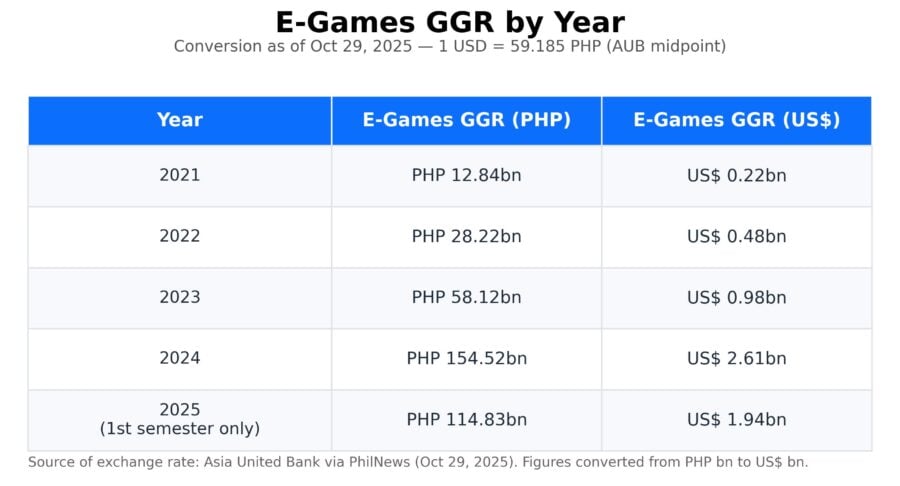
The Electronic Games sector – composed of E-Games, E-Bingo, and Bingo grantees – contributed PHP114.83bn or 53.47 per cent of total GGR.
Licensed casinos, meanwhile, also remained a significant revenue driver, generating revenues totalling PHP93.36bn or 43.47 per cent of the industry GGR. PAGCOR-operated casinos added PHP6.56bn, representing 3.06 per cent of the overall industry performance.
Competition across the Asian gaming market is intensifying, yet the Philippine industry continues to grow and maintain a strong position. What do you see as the key factors driving this success?
A major factor driving the growth of the Philippine gaming industry is the rise of the e-gaming sector.
Since the Covid-19 pandemic, there has been a paradigm shift in consumer behaviour as people turned to digital trading platforms for food, shopping, news, and entertainment, which includes gambling. This is a worldwide phenomenon, not just in the Philippines.
The GGR for online gaming demonstrates a yearly upward trend, showing how its popularity has contributed to the growth of the local gaming industry:

Despite the closure and prohibition of POGOs in the country, economic growth occurred. Were you surprised, or did you already know that this measure would not be detrimental to the regulator’s revenue?
Before it was finally closed for good, revenues from offshore games contributed PHP38.14bn in gross gaming revenues to the PHP410.47bn GGR generated by the Philippine gaming industry in 2024.
However, the majority of the GGR still came from land-based casinos and, most especially, the emerging e-games sector.
Thus, while the loss from POGO operations was significant, we were confident that it would be offset by gains in the e-games sector.
We partly attribute the strong performance of the sector to the strategic policy adjustments that we implemented, such as the gradual reduction of fee rates for E-Games since 2023.
Previously, PAGCOR was collecting licence fees between 50 and 55 per cent of GGR, which limited expansion. But effective January 1, 2025, our fee rate for egames is now only 30 per cent of GGR.
These reductions encouraged unregistered operators to join the regulated market while preventing voluntary closures and sustaining profitability among licensed operators.
Looking ahead, do you think POGOs could become legal again in the country?
The decision would have to come from the President. However, we do not see this happening any time soon.
There has been much discussion about the plan to privatise PAGCOR-operated casinos. What is the status of this plan?
Preparations to decouple PAGCOR’s casino operations are continuing, with regular consultations being done with the Governance Commission for GOCCs, which needs to approve any changes in PAGCOR’s organisational structure.
We are also preparing for the financial implications of the decoupling to ensure that affected employees will get separation benefits that would allow them to transition seamlessly to life after PAGCOR.
“Preparations to decouple PAGCOR’s casino operations are continuing.”
PAGCOR representative.
Once privatisation does occur, how do you envision PAGCOR’s role evolving within the Philippine gaming industry?
Once PAGCOR completes the decoupling process and its Casino Filipino properties are privatised, PAGCOR will become a purely regulatory and policy-setting body focused on licensing gaming entities, enforcing compliance with laws and responsible gaming standards, and ensuring fair play across the industry.
PAGCOR’s focus will also shift toward strengthening coordination with other government bodies such as the Anti-Money Laundering Council, National Bureau of Investigation, Philippine National Police, the Central Bank and Bureau of Internal Revenue to combat illegal gambling and financial crimes more effectively.
PAGCOR will also be better positioned to push for legislative reforms that modernise gaming laws and adapt to emerging technologies, and ensure a more competitive, responsible, and investor-friendly gaming environment while safeguarding consumer welfare.
Although it will no longer directly run casinos, PAGCOR could potentially contribute even more to government revenues through licensing fees and regulatory charges. It will also no longer need to spend on rental fees, manpower costs, and other operational expenses for its casinos.
What are PAGCOR’s top regulatory and operational priorities for the remainder of 2025?
As it navigates the rest of 2025, PAGCOR’s focus is clear: to strengthen its regulatory role, safeguard the integrity of the gaming industry, and ensure that gaming continues to contribute to national development in a responsible and sustainable way.
The agency has recently formalised its partnership with the Ad Standards Council to formulate guidelines for the advertising and promotion of gambling activities, in order to protect vulnerable sectors — particularly minors — from exposure to harmful content.
A PAGCOR spokesperson spoke to Focus Gaming News about legislative reforms, the proposal to ban online gaming, illegal market risks, privatisation plans, and 2025 regulatory priorities. Exclusive interview.- The gambling…